Near midnight, a stranger walking through the historic streets of Brooklyn noticed a faint light seeping through an apartment window. This light seemed to be sending a mysterious message to the world. Behind the window, a man leaned over an old wooden desk, designing something. His eyes gleamed with determination, as if the design in his hand was just the beginning. This man was Rob Kalin, and without realizing it, he was taking the first steps of one of the digital age’s most creative revolutions.
Rob Kalin’s life was preparing to move beyond that of an ordinary furniture designer. Kalin was frustrated by the lack of a suitable place to sell his handmade furniture. The mass-produced world offered by giant e-commerce titans left no room for the unique, personal touches of hand craftsmanship he envisioned. This problem fueled the fire within him. Overnight, he decided to create a solution to fill this gap. However, this was only the start.
To turn his dream into reality, Kalin teamed up with old friends Chris Maguire and Haim Schoppik. Yet, the team felt something was missing. At that point, Jared Tarbell, a mathematics and computer genius, joined them. Gathering in the narrow streets of Brooklyn, the team merged their unique talents and visions. Their late-night meetings were filled with intense discussions and creative ideas. As artists in their own right, this team aimed to create not just a marketplace, but a community. Thus, the foundations of Etsy were laid.
The Rise of a Creative Community
Etsy’s early years were like an artist’s struggle to emerge from the shadows into the light. Initially, the platform had a simple, user-friendly interface, but it continued to grow and evolve with every passing day. Etsy’s uniqueness lay not only in the products sold but in how sellers reflected their own stories and creativity onto the platform. This transformed Etsy from an ordinary marketplace into an artist’s paradise.
In 2008, a new character joined the Etsy story: Maria Thomas. With her appointment as CEO, Thomas made strategic moves to bring Etsy out of the shadows and to a wider audience. Steps such as enhancing user experience, improving payment systems, and strengthening customer service led to rapid growth. Under her leadership, Etsy was becoming a global community. During this period, Etsy’s sales and user numbers skyrocketed, becoming a beacon of hope for small businesses and independent artisans.
In 2015, Etsy took another giant leap and went public. Trading on the NASDAQ, Etsy expanded even further globally. The IPO allowed the platform to increase its financial resources, enabling more innovation. During this time, Etsy focused on providing a better experience for both sellers and buyers by adopting principles of sustainability and ethical trade.
Today, Etsy is an indispensable platform for people seeking handmade and unique items, boasting millions of active buyers and sellers worldwide. The story of Etsy is an inspiring example of how an idea can turn into a global movement.
Etsy by the Numbers (2026 Insights)
Here are some key statistics regarding Etsy’s current standing:
Gross Merchandise Sales (GMS) Reached $12.72 Billion: GMS represents the total value of all items sold. In 2024, Etsy’s total GMS was approximately $12.72 billion.
Record Revenue of $2.85 Billion: Despite a slight softening in GMS, revenue continued to grow, marking a 1.98% increase over the previous year.
454 Million Monthly Visitors: Etsy continues to be a high-traffic platform, attracting roughly 454.6 million visitors per month worldwide.
Six Categories Dominate 90% of GMS: These include Home & Living (approx. 34%), Jewelry & Accessories, Clothing, Craft Supplies, Paper & Party Supplies, and Toys & Games.
Over 100 Million Active Listings: The marketplace remains highly competitive, requiring sellers to focus heavily on SEO and product photography.
8.1 Million Active Sellers: The “creative economy” continues to thrive with a resilient community of over 8 million sellers.
86 Million Active Buyers: While there has been a slight year-over-year dip, the total consolidated buyer base (including Depop) remains strong at 93.1 million.
Repeat Buyers are Key: Approximately 36.9 million people are repeat buyers, having shopped on two or more days in the past year.
“Habitual” Buyers: This high-value segment—6 million people—spent $200 or more and shopped on six or more different days in the past year.
86% of Sellers are Women: About 9 out of 10 Etsy sellers run their shops alone, mostly from home, highlighting the platform’s importance for independent creators.
Dominated by Millennials: Users aged 25–34 make up nearly 29% of the traffic, making it attractive for both Gen Z trend-seekers and Millennials with established purchasing power.
Customization is King: Roughly 33% of all sales involve personalized or custom-made items.
Mobile-First Shopping: 64% of traffic comes from mobile devices, with mobile sales accounting for 46% of total GMS.
Conclusion and Personal Experience
Founded in 2005, Etsy allows you to make money by selling handmade goods, vintage items, and digital products.
Etsy has become the number one marketplace for customizable products. Recently, they have focused heavily on “gifting.” During special occasions like Mother’s Day, Valentine’s Day, or Christmas, orders can increase 10 to 20 times. Furthermore, because products are custom-made, customers are willing to pay more, resulting in more profitable sales for us.
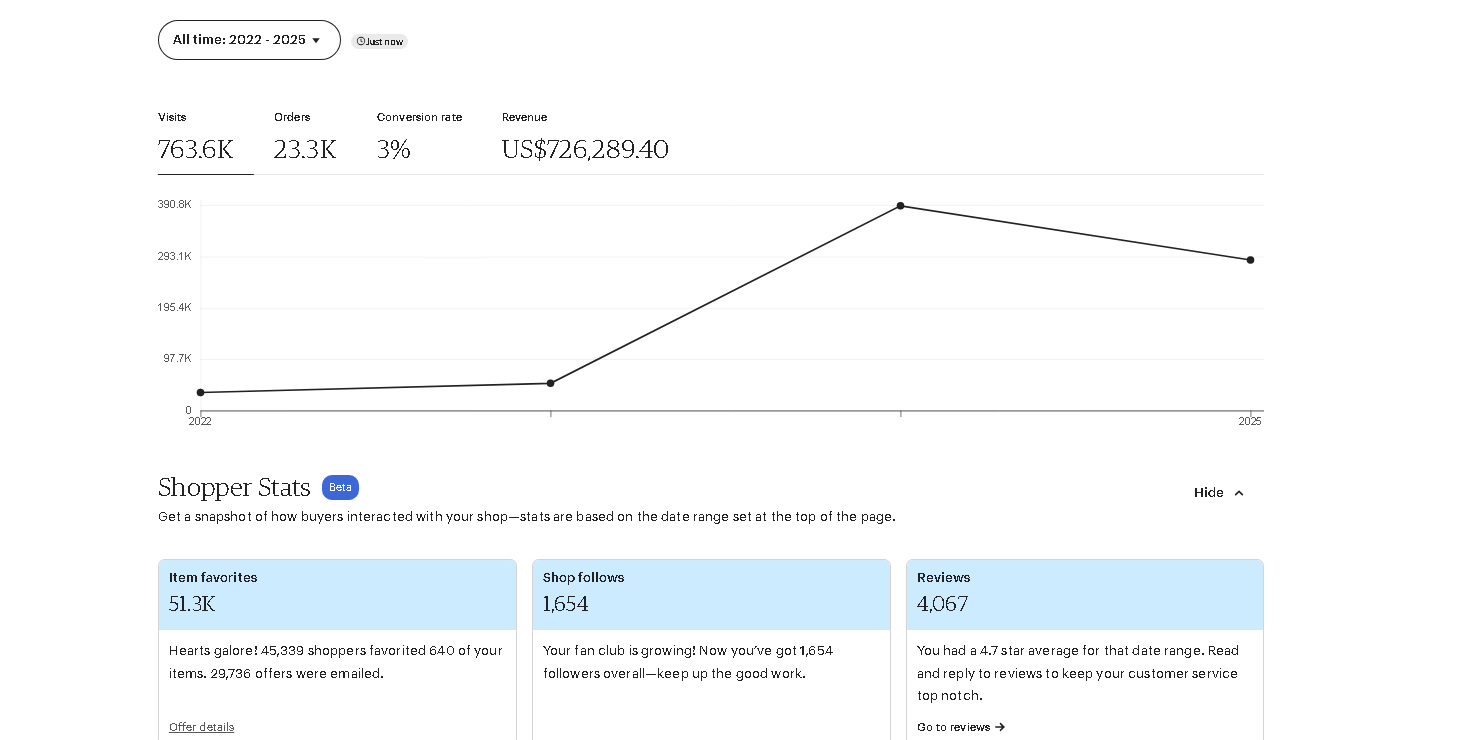
I started my e-commerce journey in 2018 by buying products from Alibaba and selling them on Amazon. In 2021, Etsy caught my attention. We have been selling on the platform for over 4 years now. While I had a few attempts before April 2022, that was the month we officially began selling personalized jewelry.
Since opening in April 2022, our shop has reached 23,300+ orders and $726,289 in total sales.